Hack Squats vs. Traditional Squats: The Quad-Building Truth
Hack squats vs. traditional squats for quad growth after 50 — break down the biomechanics, muscle activation, and joint safety to build smarter.

Fit Life 50+ Staff
Fitness and wellness resources for adults over 50
Hack squats vs. traditional squats for quad growth after 50 — break down the biomechanics, muscle activation, and joint safety to build smarter.
Why This Debate Actually Matters for Lifters Over 50
If you've spent any time on fitness YouTube lately, you've seen it — loaded hack squat machines, brutal sets, trainers swearing it's the ultimate quad builder. And maybe you've wondered: should I be doing that instead of my regular squats?
Here's why this question deserves a real answer. After 50, the stakes around exercise selection go up. You're not just chasing size — you're also managing recovery, protecting your joints, and building a routine you can sustain for decades. Choosing the wrong tool for the wrong reason can stall your progress or sideline you entirely.
But here's the empowering part: understanding why an exercise works gives you control. When you know the biomechanics behind hack squats and traditional squats, you stop guessing and start programming with intention. That's not an age thing — that's a smart-lifter thing. Let's break it down.
The Biomechanics: How Each Squat Actually Loads Your Quads
The key difference between these two movements comes down to torso position and load path.

Photo by Jason Morrison on Pexels
In a traditional barbell squat, the weight sits on your back. To stay balanced, your torso hinges forward — especially as depth increases. This forward lean shifts demand toward your hips, glutes, and lower back. Your quads work hard, but they're sharing the stage with several other muscle groups. That's not a flaw — it makes the barbell squat an elite full-body strength movement.
In a hack squat machine, your back is supported against a padded carriage. This forces a more upright torso, which dramatically increases the knee-flexion angle and keeps your quads under tension throughout a greater range of motion. Less hip involvement means your quads can't offload the work — they own the movement.
In biomechanical terms, the hack squat creates a longer moment arm at the knee joint relative to the hip. Translation: your quadriceps are doing more work per rep. For pure quad hypertrophy, that's a significant mechanical advantage.
Muscle Activation: What the Research Generally Shows
Electromyography (EMG) research on squat variations consistently points in the same direction: the more upright your torso, the more your quads dominate. The hack squat's fixed, reclined back position forces exactly that — an upright shin-and-torso relationship that lights up the rectus femoris and vastus muscles with fewer competing demands.
Traditional squats, by contrast, produce strong activation across a broader pattern — quads, glutes, hamstrings, spinal erectors, and core all contribute meaningfully. This makes the barbell squat a more efficient movement for overall lower-body development, but a less targeted stimulus for the quads alone.
Why does this matter after 50? Because targeted quad strength is directly linked to knee joint stability and long-term mobility. Strong quads protect the knee. If your barbell squat technique compensates around an old hip issue or limited ankle mobility, you may actually be underloading your quads without realizing it. The hack squat removes those variables and delivers the stimulus directly.
Joint Safety: Honest Pros and Cons for Each Movement
Let's be straight — neither exercise is inherently dangerous, and neither is automatically safe. Technique and load selection determine safety, not the movement itself.
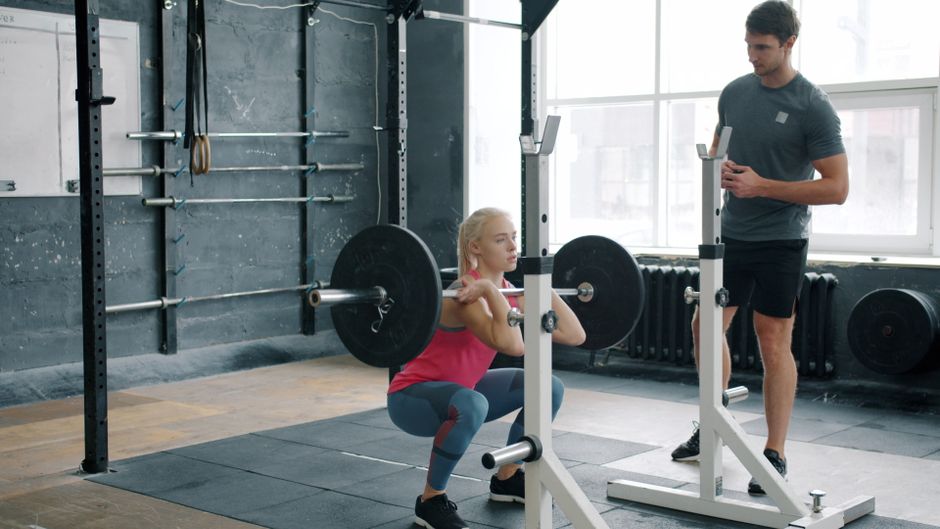
Photo by Vitaly Gariev on Pexels
Traditional squat considerations:
- Requires adequate ankle dorsiflexion, hip mobility, and thoracic extension
- Spinal compression from axial loading is real — respect it with progressive loading
- Poor mobility often leads to compensations (butt wink, forward cave) that increase injury risk
- Can be modified with heel elevation, goblet squat variations, or safety bar
Hack squat considerations:
- The machine guides the path, reducing balance and stabilizer demand — this is an advantage and a limitation
- Knee shear forces increase at depth; if you have pre-existing knee issues, depth management matters
- Because the machine enables heavier loading safely, ego-loading becomes a real risk — don't let the machine fool you into going heavier than your joints are ready for
- Generally more accessible for lifters with lower back sensitivity or limited hip mobility
Bottom line: the hack squat's controlled path is often more joint-friendly for lifters managing mobility limitations — but only when loaded with discipline.
Progressive Overload: Which One Lets You Push Harder, Longer
Progressive overload — systematically increasing the demand on your muscles over time — is the non-negotiable engine of strength and muscle gains at any age. So which squat variation gives you more room to progress?
The traditional squat has a higher skill ceiling. Progress depends on both strength and technique, which means early gains come quickly but plateaus require real problem-solving. For lifters who've mastered the movement, it remains one of the best long-term strength builders in existence.
The hack squat machine, however, offers a more linear and accessible overload path for many lifters. Because the movement pattern is fixed, you can focus purely on adding load or reps without the technical complexity. For 50+ lifters who want to drive quad hypertrophy without rebuilding their squat mechanics from scratch, this is genuinely valuable.
The smart approach is not either/or. Use the traditional squat for overall lower-body strength and functional carryover. Use the hack squat as a hypertrophy tool — a quad finisher, a primary movement on machine days, or a primary lift when back health demands it. Both have a seat at the table in an intelligent program.
When Each Exercise Actually Wins
Here's the practical breakdown — no fluff:
Choose traditional squats when:
- You want full-body lower-body development (quads, glutes, hamstrings, core)
- Functional strength and real-world carryover is a priority
- You're building a foundation of movement competency
- You have the mobility and technique to execute them well
Choose hack squats when:
- Maximizing quad hypertrophy is the specific goal
- You have lower back sensitivity that makes axial loading uncomfortable
- Mobility limitations compromise your barbell squat depth or alignment
- You want to add training volume without hammering your spine
- You're in a phase focused on machine-based training for joint recovery
Use both when:
- You want the best of both worlds — strength and size
- Your program has room for a compound lift plus an accessory
- You're rotating movements to avoid overuse patterns
Remember: the best exercise is the one you can perform safely with progressive overload over time. For some lifters that's the barbell squat. For others it's the hack squat. For many, it's both — intelligently programmed.
Conclusion
The hack squat vs. traditional squat debate doesn't have one winner — it has a right answer for you, right now, based on your mobility, your history, and your goals. If pure quad development is on your agenda, the hack squat earns its trending status. If total lower-body strength and athletic carryover matter, the barbell squat remains irreplaceable. Your actionable takeaway: this week, assess your current squat variation and ask honestly — are my quads actually getting the stimulus I think they are? If not, it might be time to add the hack squat to your arsenal. Strong today, strong tomorrow, strong for life.
Take the Next Step
Put the Knowledge
Into Action
Send a question or use the starter resources to plan your next practical step.