Alan Ritchson's 3-Move Arm Builder: Real or Hype?
Alan Ritchson's arm workout looks impressive, but does it hold up for 50+ lifters? We break it down against real hypertrophy science.
Fit Life 50+ Staff
Fitness and wellness resources for adults over 50
Alan Ritchson's arm workout looks impressive, but does it hold up for 50+ lifters? We break it down against real hypertrophy science.
Who Is Alan Ritchson and Why Should You Care?
If you've seen Reacher on Prime Video, you already know Alan Ritchson's arms are hard to ignore. The man is built like a human tank, and fitness media has been tripping over itself to cover his training methods. His widely discussed 3-move arm routine — built around barbell curls, overhead tricep extensions, and hammer curls — has been framed as some kind of secret weapon for sleeve-busting size.
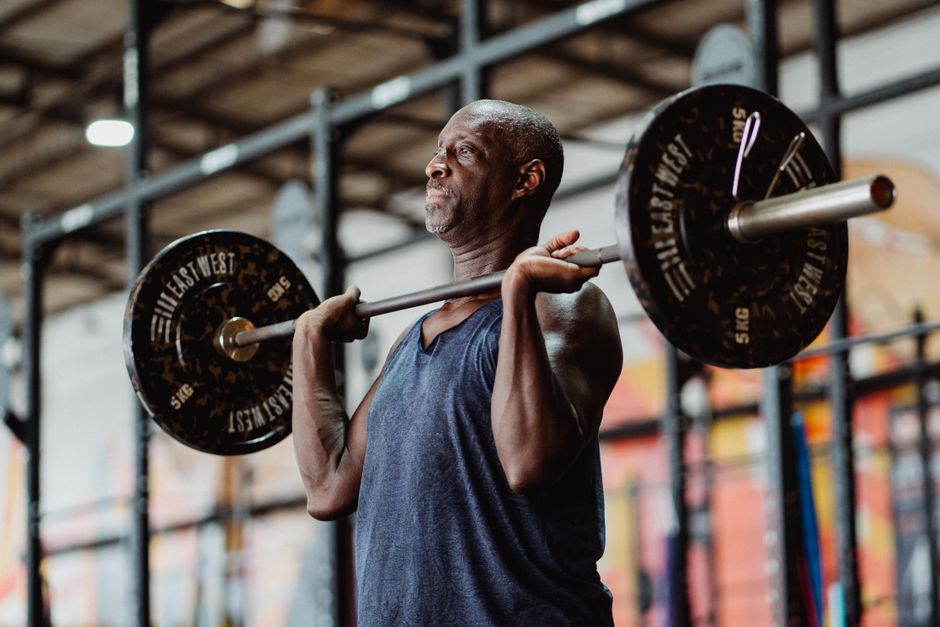
Photo by Ketut Subiyanto on Pexels
Here's the honest truth: Ritchson's arms didn't come from three exercises. They came from years of consistent, progressive training, dialed-in nutrition, and genetics that most of us didn't win in the lottery. That doesn't mean his routine is worthless. It means we need to stop treating celebrity workouts like gospel and start asking a better question: does the underlying structure actually align with how muscles grow?
For lifters over 50 especially, separating the marketing from the mechanism is everything. Your time is valuable. Your joints deserve respect. And your goals are real — so let's treat them that way.
Breaking Down the 3 Moves
Let's look at what the routine actually includes and why each movement earns — or doesn't earn — its spot.
Barbell Curl — A classic for a reason. The barbell curl loads the biceps through a strong mechanical disadvantage, creates high tension at the peak contraction, and allows for meaningful progressive overload. For 50+ lifters, wrist positioning can be an issue. If straight-bar curls aggravate the wrists or elbows, an EZ-bar swap is a smart, science-neutral substitution.
Overhead Tricep Extension — This is actually the most underrated move in the trio. Research consistently supports training muscles in their lengthened position for superior hypertrophy, and the overhead extension does exactly that — it stretches the long head of the tricep under load. For older lifters with shoulder limitations, a cable rope variation from a low pulley is an excellent alternative.
Hammer Curl — Targets the brachialis (underneath the bicep) and brachioradialis, adding thickness to the arm that standard curls can't fully develop. It's also generally easier on the wrists than supinated curl variations. A smart inclusion.
All three are legitimate movements. The issue isn't the exercises — it's what often surrounds them in the celebrity write-up.
What Hypertrophy Science Actually Tells Us
Muscle growth — at any age — comes down to a handful of non-negotiable principles. Celebrity routines rise or fall on how well they honor these principles, not on how famous the person doing them is.
Mechanical tension is the primary driver of hypertrophy. You need to challenge the muscle with sufficient load, through a full range of motion, with enough proximity to muscular failure to trigger an adaptive response. Three moves absolutely can deliver this — if the sets, reps, and effort levels are appropriate.
Volume matters — but so does recovery. For lifters over 50, recovery capacity shifts. It doesn't disappear, but it changes. Research supports the idea that older trainees may benefit from slightly more recovery time between sessions targeting the same muscle group, while still responding robustly to progressive overload training. Translation: you don't need to train arms five days a week. Two quality sessions, built around progression, will outperform four sloppy ones.
Progressive overload is non-negotiable. If you're doing the same weight, same reps, same tempo every week — you're maintaining, not building. Ritchson's routine, like any routine, only works if you're consistently pushing adaptation. Three moves done progressively will always beat ten moves done casually.
The 50+ Factor: What Changes, What Doesn't
Let's address the elephant in the room directly: yes, hormonal shifts after 50 — particularly declining testosterone and growth hormone — can slow muscle protein synthesis. But the research is clear that resistance training remains one of the most powerful tools for building and preserving muscle at any age. The physiology changes; the capacity doesn't disappear.

Photo by Anna Shvets on Pexels
What does require adjustment is your approach to managing fatigue and joint stress. Barbell curls with maximal loads and sloppy form are a recipe for elbow tendinopathy. Overhead extensions with too-heavy dumbbells and compressed ROM will aggravate the shoulder. The answer isn't to avoid these movements — it's to execute them with better technique than you did at 30.
Key form cues for this routine:
- Barbell curl: Keep elbows pinned to your sides. Do not swing the torso. Exhale on the curl, inhale on the descent. Full extension at the bottom.
- Overhead extension: Set the shoulder first. Keep elbows pointing forward, not flared. Lower slowly — a 3-second eccentric builds more muscle and protects the joint.
- Hammer curl: Neutral wrist throughout. No supination. Control the descent.
Form is the variable you control completely. Use that.
So Does the Routine Actually Work?
Yes — with conditions. Three movements targeting the biceps, brachialis, and triceps can absolutely form the foundation of a productive arm training block. The routine is mechanically sound, hits the major muscle groups of the upper arm, and includes at least one exercise (the overhead extension) that modern hypertrophy research would enthusiastically endorse.
But here's what the magazine article won't tell you: Ritchson likely didn't build those arms doing three sets of three exercises. His training almost certainly involves significantly more volume, periodization, and nutritional precision than a celebrity fitness profile captures. Three moves might be what he highlighted in an interview. It is not the whole picture.
For a 50+ lifter building a real program, this trio works best as a focused accessory block — 3 to 4 sets per exercise, 8 to 15 reps per set, taken to within a rep or two of failure, performed twice weekly with adequate protein intake (research consistently points toward higher protein needs for older adults maintaining or building muscle — aim for adequate daily totals, not minimal ones).
Add progressive overload every one to two weeks — even by small increments — and you have a legitimate arm-building protocol backed by actual science, not just screen time.
Building Your Own Version: A Practical Framework
Rather than copying a celebrity's routine wholesale, use it as a starting template and personalize it around your body's real feedback. Here's how to structure a 50+-smart version of this approach.
Option A — Beginner/Joint-Sensitive:
- EZ-bar curl: 3 sets × 10–12 reps
- Cable rope overhead extension (low pulley): 3 sets × 12–15 reps
- Hammer curl (light, full ROM): 3 sets × 12 reps
Option B — Intermediate/Progressive:
- Barbell curl: 4 sets × 8–10 reps
- Dumbbell overhead extension: 4 sets × 10–12 reps (3-second eccentric)
- Hammer curl: 3 sets × 10–12 reps
Progression model: Add one rep per set before adding weight. Once you hit the top of the rep range with solid form, increase load by the smallest increment available. This is progressive overload — unglamorous, essential, and completely proven.
Recovery: 48–72 hours before training the same muscles again. Sleep and protein are not optional recovery tools — they are the recovery tools. Aim for consistent sleep and prioritize protein at each meal, especially post-training.
This isn't Ritchson's routine anymore. It's yours — and it's built to last.
Conclusion
Alan Ritchson's 3-move arm routine isn't magic — but it isn't nonsense either. Strip away the celebrity packaging and you'll find three legitimate exercises grounded in sound movement principles. The real question was never whether the moves work. It's whether you're applying progressive overload, training with sufficient effort, recovering properly, and eating enough protein to support muscle protein synthesis. Those variables determine your results far more than whose name is attached to the workout. Your one actionable takeaway: pick two of these three exercises this week, log your sets and reps, and commit to beating those numbers next session. That's the whole game. Strong Today. Strong Tomorrow. Strong for Life.
Take the Next Step
Put the Knowledge
Into Action
Send a question or use the starter resources to plan your next practical step.