5 Quad Builders That Work Better Than Squats
Skip the squat rack and try these 5 biomechanically smarter quad exercises that build serious leg mass while protecting your knees and hips.
Fit Life 50+ Staff
Fitness and wellness resources for adults over 50
Skip the squat rack and try these 5 biomechanically smarter quad exercises that build serious leg mass while protecting your knees and hips.
Why Squats Aren't the Only Path to Big Quads
Squats are a cornerstone of leg training — nobody's arguing that. But here's the truth most training programs won't tell you: the squat is primarily a hip-dominant movement. Your glutes, hamstrings, and lower back share a significant portion of the load. If your goal is specifically quad development, you're leaving gains on the table every time you default to the back squat without including more targeted work.
Photo by @marcuschanmedia | IG on Pexels
This matters even more once you factor in individual anatomy. Hip socket depth, femur length, and ankle mobility all affect how much quad recruitment you actually get from a standard squat. Two people can perform the exact same movement and get dramatically different results from it.
The exercises in this article isolate and challenge the quadriceps through a fuller range of motion, with greater time under tension, and in positions that reduce compressive joint stress — not eliminate challenge, but redirect it more intelligently. Build smarter, not just harder.
The 5 Exercises You're Probably Skipping
1. Leg Press with High Foot Placement Conventional wisdom says a lower foot position targets quads — and it does. But placing your feet slightly higher on the platform while keeping a moderate stance allows a deeper range of motion with less shear force on the knee joint. Focus on controlling the descent fully before pressing through your heels.
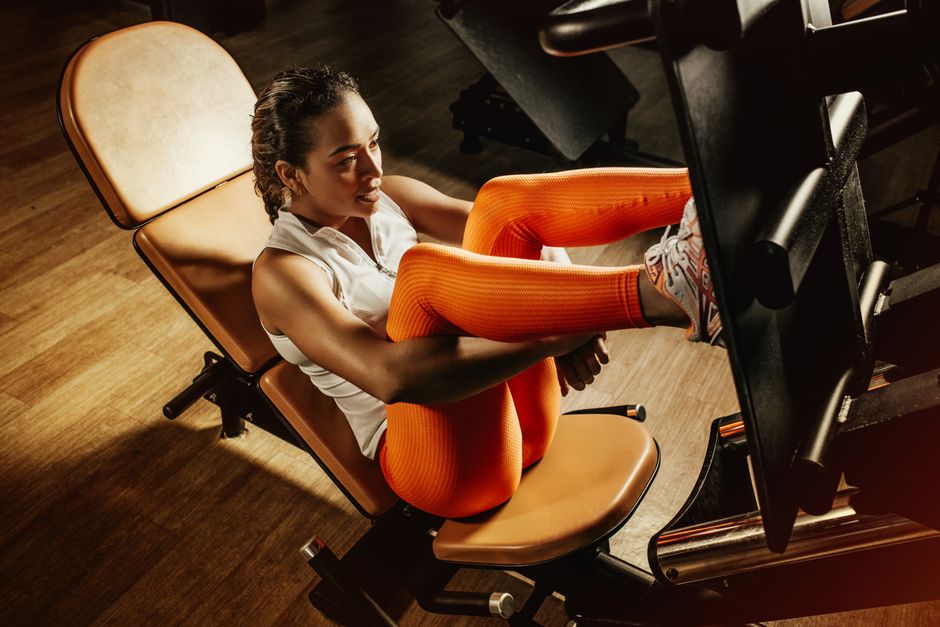
Photo by Jonathan Borba on Pexels
2. Sissy Squat (Loaded or Bodyweight) Do not let the name fool you. The sissy squat places the quads under extreme stretch at the bottom position — exactly the stimulus research links to hypertrophy. Use a support pole to start, keep your hips extended, and lower slowly. This is an advanced movement — earn it with bodyweight first.
3. Spanish Squat (Banded) Using a resistance band anchored to a rack, you lean back and descend into a near-vertical shin position. This removes most hip flexor involvement and keeps constant tension on the quads throughout the movement.
4. Reverse Nordic Curl Kneeling on a padded surface, you lean backward under control while keeping your hips extended. This eccentrically loads the rectus femoris — the only quad muscle that crosses the hip — in a way almost nothing else does.
5. Cyclist Squat (Heel-Elevated Goblet Squat) Elevating your heels on plates or a wedge dramatically increases quad recruitment by shifting your torso upright and increasing knee travel. Hold a dumbbell or kettlebell at your chest for load.
Proper Form and Breathing for Each Movement
Form isn't optional — it's the entire mechanism through which these exercises work.
For the Leg Press: Inhale at the top, brace your core, and exhale as you press through the bottom third of the rep. Never let your lower back peel off the pad at the bottom of the range. Full range of motion is the goal, not maximum weight.
For the Sissy Squat: Keep your hips fully extended throughout the movement — the moment your hips break, you've converted it into a regular squat. Exhale on the way up. Use a slow, 3-4 second descent before you add any load.
For the Spanish Squat: Breathe in at the top, brace, then exhale through the press. The band is pulling you forward — resist that tension actively through your entire midsection.
For the Reverse Nordic: This is an eccentric-dominant exercise. Inhale as you lower for a controlled 4-5 seconds. Focus entirely on resisting gravity. Hip extension is everything here — sagging hips turns it into a back exercise.
For the Cyclist Squat: Inhale at the top, drive your knees forward over your toes intentionally, and exhale as you stand. Keep your chest tall throughout. The heel elevation is doing the biomechanical work — let it.
Modifications for Every Fitness Level
One of the best things about this exercise selection is that every single movement scales — down for beginners, up for experienced lifters.
Beginner modifications:
- Sissy Squat → Start with just bodyweight and a firm support. Limit your range of motion until hip extension control is solid.
- Reverse Nordic → Do isometric holds at the bottom position before attempting full reps.
- Cyclist Squat → Use only bodyweight with your heels elevated on a folded mat before adding load.
Intermediate progressions:
- Add slow eccentric tempos (3-4 seconds down) to any of these movements before increasing weight.
- Pair Spanish Squats with Cyclist Squats in a superset for a deep quad-fatigue protocol.
Advanced loading:
- Add a weight plate to the chest during Sissy Squats.
- Use a barbell in the goblet position for Cyclist Squats.
- Perform Reverse Nordics off a slight decline to increase the range of motion.
The principle is always the same: master the movement pattern before chasing the load. Longevity over ego — that's not just a phrase, it's a training strategy.
How to Add These to Your Current Leg Day
You don't need to scrap your existing program. These exercises are designed to complement your current training, not replace every compound lift you've built your routine around.
A practical integration approach:
- Replace one squat variation per session with a Cyclist Squat or Spanish Squat. Run that for 4 weeks before evaluating.
- Add the Sissy Squat or Reverse Nordic as a finisher — 3 sets at the end of leg day, after your primary lifts are complete. The muscles are pre-fatigued and will respond strongly to the targeted stimulus.
- Use the Leg Press (repositioned) as your secondary compound movement after a primary squat or deadlift.
A sample quad-focused block might look like this:
- Barbell Back Squat — 4 x 5 (strength focus)
- Cyclist Squat — 3 x 10-12
- Leg Press (high foot) — 3 x 12-15
- Sissy Squat — 3 x 8-10
- Reverse Nordic — 2 x 6 slow eccentrics
Apply progressive overload consistently — add reps, slow the tempo, or increase load every 1-2 weeks. That's what drives adaptation, regardless of which exercises you choose.
The Joint-Protection Case for Smarter Quad Training
Let's address the real reason people gravitate toward squats and never experiment further: familiarity. Squats feel productive because they are — but "productive" and "optimal" aren't always the same word.
High-volume heavy squatting under suboptimal mechanics — whether due to mobility limitations, old injuries, or simple anatomy — creates cumulative compressive load on the knees and lumbar spine. That load adds up over months and years.
The movements in this list were selected partly because they allow meaningful quad training at lower spinal loads. The Cyclist Squat, for example, places almost none of the traditional bar-on-back axial loading on the spine while still driving significant knee flexion and quad recruitment. The Spanish Squat actively reduces forward shear on the knee.
This isn't about going soft. It's about being strategic enough to train hard for decades, not just seasons. The athletes and lifters who stay in the game longest aren't the ones who lifted the heaviest — they're the ones who trained the smartest.
Strong today means making choices now that keep you strong tomorrow.
Conclusion
Your quads don't know what exercise you're doing — they respond to tension, range of motion, and progressive overload. These five movements deliver all three, often more effectively and more sustainably than defaulting to squats alone. Your action step this week: pick one exercise from this list — the Cyclist Squat is the easiest entry point — and add it to your next leg day. Run it for four weeks with consistent progressive overload and pay attention to how your quads respond. Build with intention. Train with longevity in mind. Strong Today... Strong Tomorrow... Strong for Life.
Take the Next Step
Put the Knowledge
Into Action
Send a question or use the starter resources to plan your next practical step.